


The 3 AI Features Project Managers Are Starting to Expect but Are Not Getting
Mar 2
4 min read
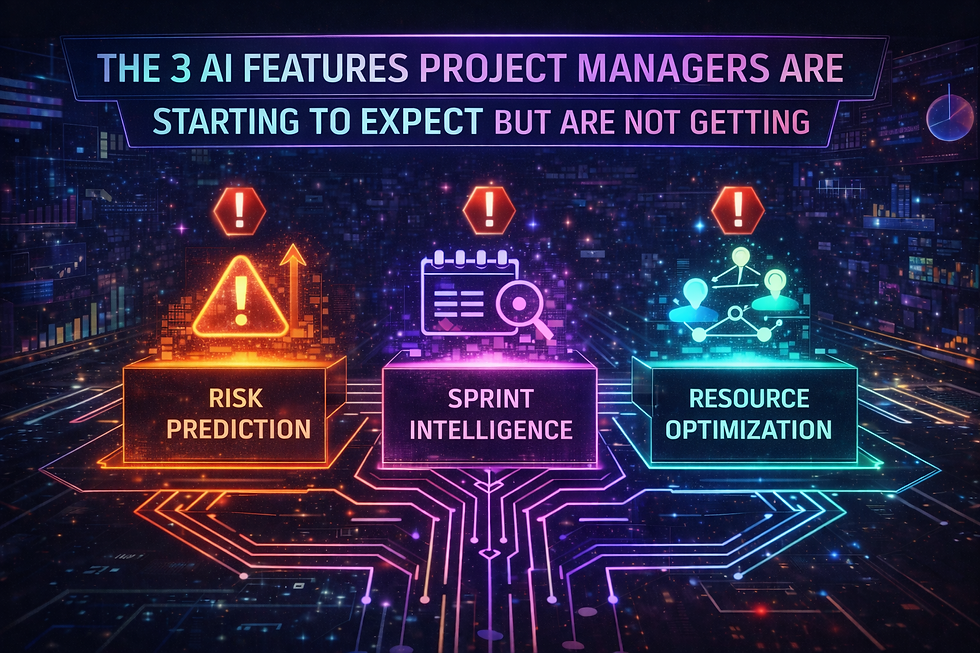
The Expectation Gap Is Real and Growing
When a feature becomes table stakes, the conversation shifts immediately to what comes next. PMs who have automated their status reports and meeting notes are not satisfied. They are asking why their tool still cannot tell them which sprint is at risk three weeks before it fails. They are asking why the AI sends them the same notifications regardless of whether those items actually need their attention. They are asking why predictive schedule data means 'this is late' rather than 'here is the probability distribution of when this will finish.'
These three features sit in a different tier from table stakes. They exist on some platforms in partial form. But the version teams are imagining when they describe what they want does not exist reliably in any of the six platforms. They are emerging, meaning the market is actively building toward them, the best implementations are ahead, and the gap between current delivery and practitioner expectation is widening.
1. Predictive Risk Identification
The version most platforms ship today is reactive risk flagging. The AI looks at overdue items, incomplete dependencies, or capacity conflicts and surfaces them as risks. That is useful. It is not the version PMs are describing when they say they want risk prediction.
The version they want looks like this: a sprint that appears on track today carries a calculated probability of missing its end date based on historical velocity for this team, the complexity profile of the remaining work, and the resource availability pattern for the next ten days. Monday.com is closest to this description. Its real-time risk detection is continuous rather than point-in-time, and its predictive timeline analysis uses historical data to produce completion forecasts. Asana's risk reports inside Smart Summaries, shipped in December 2025, identify risks and suggest mitigations, which is a meaningful step. Jira has no native risk scoring at the sprint or project level, which is the most notable absence in the market given its dominance among software delivery teams.
The constraint preventing true probabilistic risk scoring is data quality. Capterra's 2025 PM Software Trends Survey found that 39 percent of teams cite lack of clean historical data as the primary barrier to AI adoption, not the absence of features. A platform can ship a risk prediction model. It cannot make that model accurate on teams whose past sprints were not tracked consistently.
2. Intelligent Notification Filtering
The average PM using a modern work management platform receives between 30 and 80 notifications per workday. This number is not contested. What is contested is how many of those notifications actually require a decision or action. The answer most practitioners give when asked directly is somewhere between five and fifteen.
The AI feature PMs want is not simply fewer notifications. It is contextually accurate prioritization. An item assigned to someone on vacation for the next week is lower urgency than it appears in the queue. A dependency that blocks three other teams is higher urgency than its surface-level description suggests. A comment from a senior stakeholder on a Friday afternoon does not require a same-day response. A blocking issue raised by a developer thirty minutes before a production deployment does.
No platform in the comparison delivers this reliably. Some platforms have notification settings and filters. None have AI that reads context across your work, your calendar, your team's communication patterns, and the downstream consequences of each item to produce a ranked daily action list that is accurate enough to trust. This is the most requested capability among the practitioners we track, and the most technically difficult to build well. We cover why in detail in Article 2B.
3. AI-Assisted Sprint Planning
Sprint planning as most Scrum teams experience it involves a senior PM or Scrum Master estimating story points based on intuition and negotiation, matching that estimate against a team's average velocity, and hoping the sprint stays coherent through the week. AI-assisted sprint planning would change at least two of those three steps.
ClickUp Brain's intelligent Planner offers the most functional version of this feature today. It can analyze task volume, team capacity, and historical sprint completion patterns to suggest a sprint composition that is more likely to succeed than one assembled purely from intuition. Jira's Rovo can help break epics into sprint-sized work and surface related issues, but it does not suggest sprint compositions based on historical team velocity. Asana and Monday.com are earlier on sprint-specific AI because both platforms are more oriented toward project and portfolio management than sprint cadences.
The version PMs are imagining includes capacity-aware sprint composition that accounts for planned time off, cross-team dependencies, and historical team-specific velocity rather than global estimates. Azure DevOps comes closest on the engineering side because the data it has is precisely the data needed: commit history, PR cycle times, issue completion patterns, and CI/CD pipeline outcomes. For non-engineering teams, that data does not exist, and the AI sprint planning feature remains a weaker recommendation engine than a true planner.
Practical Move
Pick one of these three features and run a two-week pilot on a single project. For risk prediction, ask your current tool to flag any issues it considers at risk and compare that output to what your team actually identified in retrospective. For notification prioritization, use whatever filtering your tool offers and track how often you override it. For sprint planning, let the AI suggest a sprint composition and compare it to what the team would have chosen. The gap between AI suggestion and human judgment is your baseline. The goal over six months is for that gap to narrow, not for the AI to be right every time from the start.
References
1. Capterra 2025 PM Software Trends Survey — AI Adoption Barriers — https://www.capterra.com/resources/project-management-software-trends/
2. Monday.com AI Report: Predictive Risk Detection and Timeline Forecasting — https://monday.com/blog/project-management/ai-report/
3. Asana Release Notes December 2025: Risk Reports in Smart Summaries — https://releasebot.io/updates/asana
4. Asana Intelligence: Risk Identification and Work Graph Context — Best AI Project Hub — https://bestaiprojecthub.com/execution-collaboration/asana-intelligence-ai-overview
5. ClickUp Brain Intelligent Planner: Sprint Planning and Capacity Analysis — https://clickup.com/features
6. Digital Project Manager: AI in Project Management Notification Survey 2025 — https://thedigitalprojectmanager.com/tools/microsoft-planner-vs-asana/


Comments